What NOAA actually observed
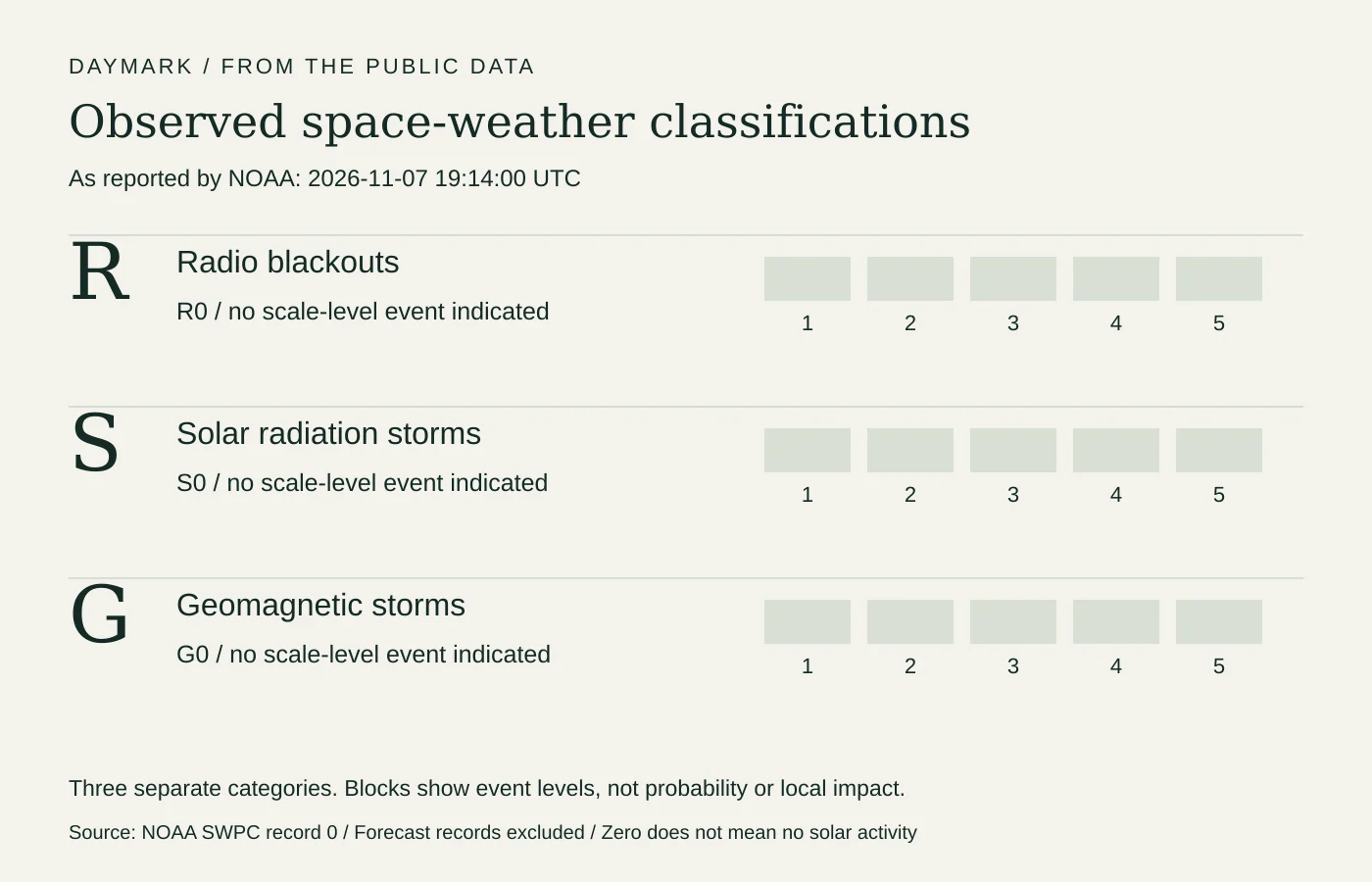
As reported by NOAA, the Space Weather Prediction Center current-observation record is time-stamped 2026-11-07 19:14:00 UTC. It reports radio-blackout level R0 (none), solar-radiation level S0 (none), and geomagnetic level G0 (none). These are three separate classifications of the space environment. Daymark reads the agency's current record and explains the numbers; it does not measure the Sun or verify the performance of individual communications systems.
The displayed values come from record 0 in NOAA's machine-readable scales product. That choice matters because the same response also contains previous-day information and forecast records. A forecast probability is not an observed event, and a predicted storm level is not evidence that the storm has already occurred. This briefing leaves those forecast values out of its figures, diagram, and headline. The observation timestamp remains visible so a reader can distinguish the source's latest report from the time this website checked it.
Why the letters cannot be combined
R describes radio blackouts. NOAA associates this scale with solar X-ray flare intensity and potential effects on high-frequency radio and navigation. S describes solar radiation storms and is associated with energetic-particle conditions. G describes geomagnetic storms and uses geomagnetic activity to classify disturbances relevant to systems such as power grids and spacecraft. The letters therefore refer to different physical processes and different kinds of possible effects; they are not interchangeable names for one universal space-weather score.
Levels 1 through 5 run from minor to extreme within each named scale. NOAA's product uses zero and the text "none" when no scale-level event is indicated in that category. A zero is not a measurement of zero solar energy, zero particles, or zero magnetic activity. Adding R, S, and G would create a number that NOAA does not publish and that has no defined unit. The diagram keeps the three rows separate rather than inventing an overall danger rating.
What this snapshot does not establish
A scale classification summarizes the reported space environment; it is not a local incident report. Even when every row is zero, the response cannot establish that every radio link, satellite receiver, or electrical installation is functioning normally. An isolated equipment problem can have many causes unrelated to space weather. Conversely, a nonzero category does not prove that every reader's device or every place on Earth is affected. Location, system design, and operational conditions matter, and they are not described by this small dataset.
Nor does this observation tell you where an aurora will be visible tonight, whether a particular flight will change route, or how an individual service will operate tomorrow. Those questions require the relevant forecast and operational information. This article makes no medical prediction, personal exposure assessment, or claim about the safety of a particular journey. For time-sensitive decisions, use the agency's official alerts and the responsible service provider rather than treating a six-hour publication refresh as a real-time warning system.
Reading the diagram and the update date
Each diagram row shows the exact reported category number and its label. The blocks show its position within that category's five named event levels; they are not a percentage, probability, or estimate of financial damage. Empty blocks at zero mean that the current product indicates no event at the scale's defined threshold. A change in one row should be read as a change in that particular classification, without assuming that the other two rows moved with it.
The retrieval time records a successful read of NOAA's product. The article-generation date advances when the reported category values change, while an unchanged R/S/G combination retains its generation date even if NOAA updates its clock. If retrieval fails or the record is malformed, this website keeps the last valid briefing and its original source-observation time. A retained report can therefore become old; the printed timestamp, rather than a reassuring-looking zero, is the first thing to check before using it.
Go to the sources
- NOAA SWPC: current scales JSON (record 0)
- NOAA: explanation of R, S, and G scales
- NOAA SWPC: official alerts and warnings
Our editorial standards explain how sources and automated briefings are handled.