Start with the people behind the label
A headline can use one enormous number to describe a humanitarian crisis. Before deciding what that number means, find its population label. Refugees, asylum-seekers, and internally displaced people are not interchangeable categories. Each describes a different relationship to a border, a protection process, or a person's place of residence. This guide explains how to read those labels; it does not estimate the size of any current emergency.
UNHCR's population documentation distinguishes refugees from other people needing international protection and from people displaced inside their own country. Refugee definitions depend on the applicable international, regional, or national framework. Crossing a border alone does not establish refugee status. Equally, formal recognition does not create a person's underlying need for protection: UNHCR explains that the legal definition is declaratory when its criteria are met.
A pending claim is a different measure
An asylum-seeker is seeking international protection while the claim remains unresolved. A table of pending asylum cases describes that administrative position. A table of new asylum applications describes activity during a period. Neither should be relabeled as the number of people newly recognized as refugees. Applications and decisions answer different questions, and their totals need not move together in a particular year.
Internally displaced people have been forced to leave their homes while remaining within their country's borders. The reason for displacement and the coverage of a dataset still matter. UNHCR's own operational IDP statistics do not provide a complete count of all global internal displacement. Its methodology also refers readers to the Internal Displacement Monitoring Centre. Read the source note before comparing an agency's assisted population with a global estimate.
Separate a snapshot from movement
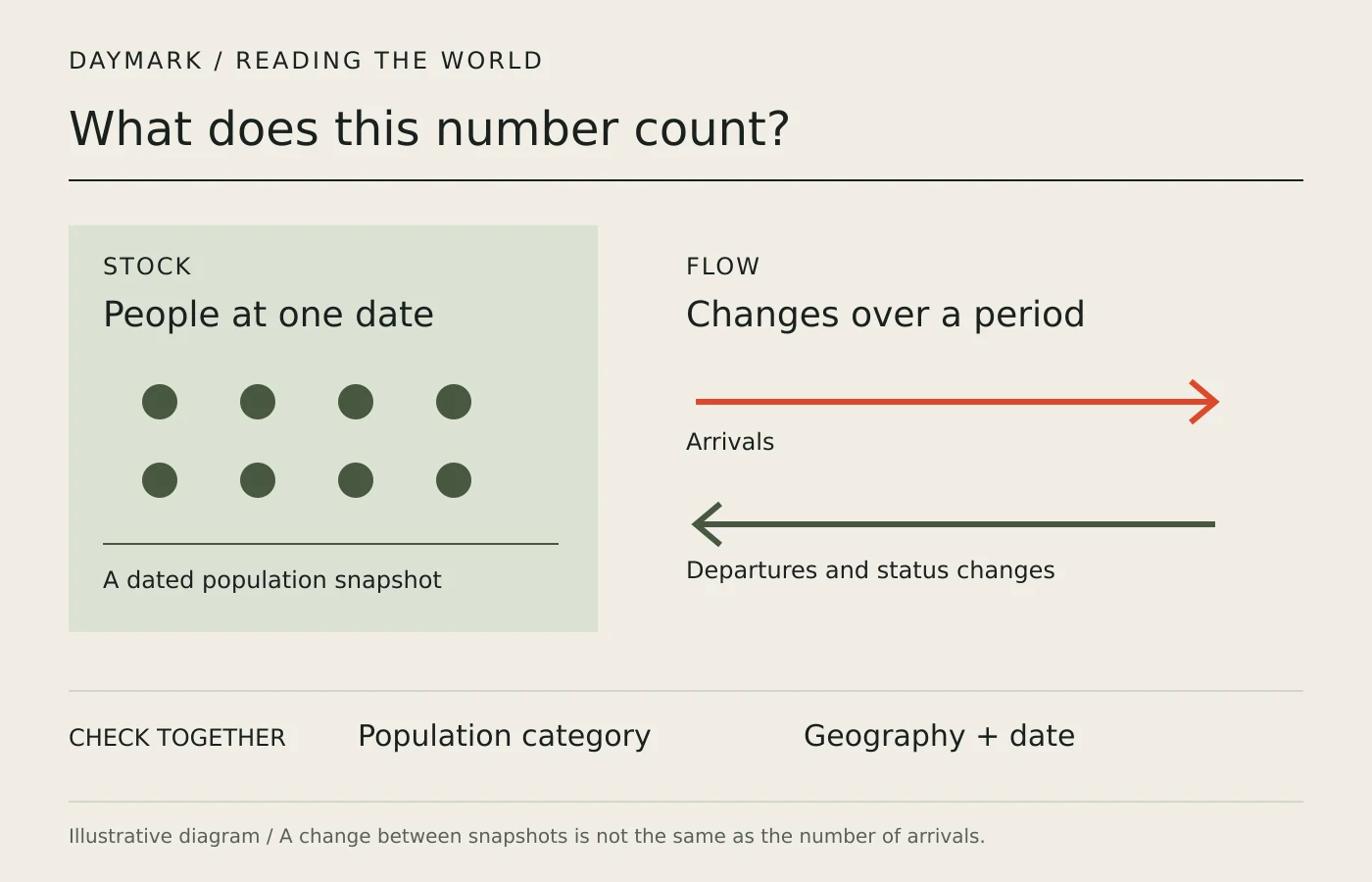
A stock is the population counted at a particular reference date. A flow records movement or a change of status over an interval. Think of a photograph and a logbook: one shows who is present on a date, while the other records what happened between dates. UNHCR's data includes both. A year-end refugee population and the year's new displacement are therefore different measurements.
Here is an illustrative calculation, not a real country report. Suppose a recorded population begins at 1,000, gains 300 people, and loses 200 during the year. It ends at 1,100. The increase is 100; it does not show that only 100 people arrived. Real datasets can also change through births, deaths, status changes, corrections, and improved coverage. Subtracting two snapshots cannot reconstruct all those events.
Check the map as carefully as the total
Country of origin and country of asylum are separate dimensions. A chart organized by origin asks where people came from. A chart organized by asylum asks where they are recorded as receiving or seeking protection. Reading an origin total as a host-country total can reverse the story. Check whether the geography is a country, territory, region, or worldwide sum and whether the same boundaries are used throughout.
The reporting date matters too. A publication released this year may primarily describe the previous year's end. Updates can arrive at different times from different authorities. Keep the reference date attached to the figure when sharing it, rather than replacing it with the date of the article you are reading. An older, clearly dated observation is more informative than a supposedly current total whose period is hidden.
Do not add categories without checking overlap
UNHCR's methodology generally assigns one reported legal status to a person, but that does not make every table safe to add. Statelessness, for example, concerns nationality and can coexist with displacement. Operational populations, returns, applications, and protection categories may follow different counting rules. Use the agency's stated aggregate when available; building your own total requires understanding how its components were defined and deduplicated.
Returns deserve the same care. A recorded return is an event or population category, not automatic evidence that every protection concern has been resolved. Read what the dataset actually measures and avoid converting a change in a table into an unsupported judgment about safety. Missing data also deserves its own label: an absent observation is not a confirmed zero and should not be plotted as one.
Make a comparison someone else can repeat
For a useful comparison, save the source URL, dataset name, population category, geography, reference date, and extraction date. Note any revision or coverage warning. If comparing two years, use the same category and methodological series, and explain any documented break. If comparing countries, check that both figures count the same thing rather than pairing an administrative caseload with a survey-based estimate.
Then write a sentence that preserves those details: the defined population in the named place at the stated time changed by the reported amount. Follow it with the limit that matters most, such as incomplete coverage or a stock-versus-flow distinction. This makes the claim traceable without pretending that a statistical table captures the full experience of people who have been forced from home.
Go to the sources
- UNHCR Refugee Data Portal: Population categories
- UNHCR: Refugee statistics methodology
- UNHCR: Common mistakes with forcibly displaced data
- UNHCR: Forced displacement flow dataset
- UNHCR Emergency Handbook: Refugee definition
Our editorial standards explain how sources and automated briefings are handled.