Approval belongs to a particular product and use
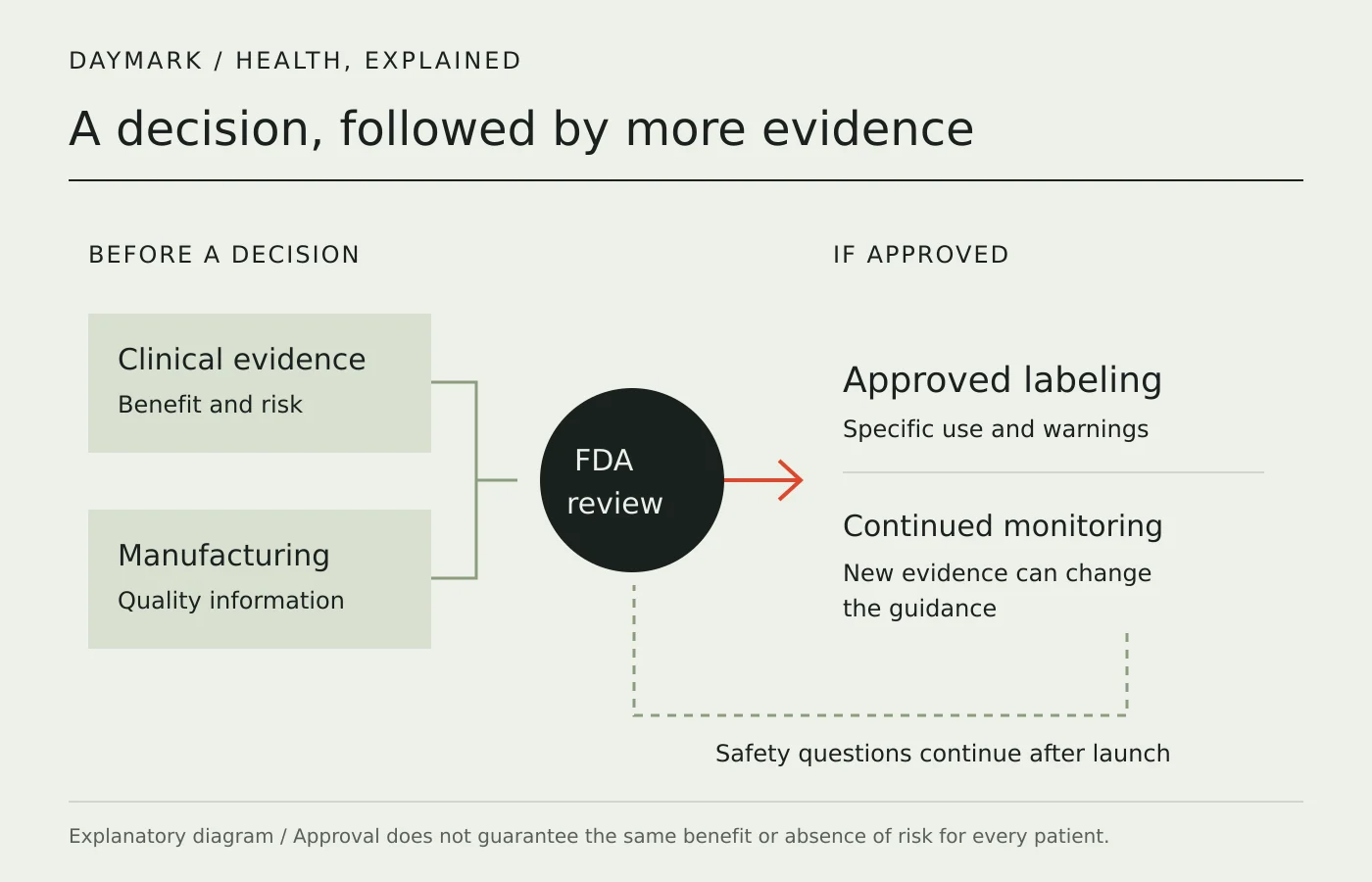
The phrase FDA approved is most informative when it names the medicine and the condition for which it was approved. The Food and Drug Administration evaluates evidence supporting a drug's safety and effectiveness for its proposed use, along with information about quality and manufacturing. It does not provide a blanket promise that the drug is appropriate for every person or every possible purpose.
Begin with the actual approved prescribing information rather than a company's short announcement. Identify the indication, patient population, dosage, contraindications, and warnings. A disease name in a headline can be broader than the population described in the approval. This guide concerns human drugs in the United States; devices, supplements, cosmetics, and other regulated products follow different frameworks and should not be treated as though they all undergo the same drug-approval process.
The sponsor produces evidence; FDA reviews it
Drug development typically begins with laboratory and preclinical work, followed by studies in people under the applicable regulatory and ethical oversight. Sponsors conduct or arrange the research and submit the evidence. FDA explains that its drug center reviews the submitted data rather than independently running all the clinical trials itself. The agency's assessment includes the design of the studies and what their results can establish.
Clinical development is commonly described in phases. Early studies investigate matters such as safety, dosing, and how a drug behaves in the body; later studies gather evidence about effectiveness and risks in the intended population. These labels describe stages of investigation, not a universal schedule or guaranteed route to approval. The number of participants, study design, and evidence needed depend on the drug, disease, and regulatory context.
Ask what improvement was actually measured
An effectiveness claim needs an outcome and a comparison. Did a study measure symptoms, hospitalization, survival, a laboratory result, or another endpoint? Who received the drug, what did the comparison group receive, and how long were participants followed? A statistically supported difference in one measurement should not automatically be rewritten as a cure or an improvement in every outcome that matters to patients.
Read the size of the benefit alongside the harms and the uncertainty. An average result in a trial does not predict an individual's response. Conditions that excluded someone from a study can also affect how directly its findings apply to that person. The question for a clinical discussion is how the evidence, existing treatments, other medicines, and personal circumstances fit together. Approval provides important evidence for that discussion; it does not replace it.
Faster pathways have specific meanings
FDA distinguishes Fast Track, Breakthrough Therapy, Priority Review, and Accelerated Approval. They address different parts of development or review. A designation can facilitate communication or change the review goal without being a marketing approval. Treat a report that a product received a designation differently from a report that an application was approved, and look for the agency's explanation of the actual decision.
Accelerated Approval can use a surrogate or intermediate clinical endpoint that is reasonably likely to predict a clinical benefit, under its applicable requirements. Such an endpoint can help make a treatment available sooner while further studies examine the anticipated benefit. It is useful to ask what was measured for approval and what follow-up evidence is required. The word accelerated should neither erase that distinction nor be used alone to dismiss the evidence.
Safety questions continue after launch
No clinical program can observe every possible patient and circumstance before a medicine reaches wider use. Continued monitoring and postmarket studies can reveal additional information about risks, effectiveness, or optimal use. FDA describes required and agreed postmarket studies as part of that process. Labeling and safety communications can change as the evidence develops, so use current information rather than relying permanently on the original approval announcement.
A suspected adverse event is important to report, but a report alone does not prove that the medicine caused it. People can experience symptoms for several reasons, and safety evaluation looks for additional evidence and patterns. FDA provides ways to learn about side effects and report concerns. For personal treatment decisions or new symptoms, discuss the situation with a qualified clinician rather than changing a prescribed regimen based only on an online account.
Use the approval as a starting document
When a new treatment makes the news, find the FDA announcement or approved label and record the exact indication. Look for the studies supporting the decision, their comparison groups, the outcome measured, and the major warnings. If an accelerated pathway is involved, identify the endpoint and follow-up requirements. Keep the approval date distinct from the dates of the underlying research and any later safety update.
Bring specific questions to a clinician: does the labeled use fit my situation, what benefit was seen in comparable patients, what risks matter with my other medicines, and what monitoring is needed? Those questions are more useful than asking whether an approved medicine is simply good or bad. The approval establishes a regulatory decision supported by evidence; using that evidence well still requires attention to the patient and the conditions of treatment.
Go to the sources
- FDA: Drug development and approval process
- FDA: The drug review process
- FDA: Fast Track, Breakthrough Therapy, Accelerated Approval, Priority Review
- FDA: Finding and learning about side effects
Our editorial standards explain how sources and automated briefings are handled.