Check the season before using an old explanation
An overtime highlight can travel online long after its rules changed. For the 2026 NFL season, an offensive touchdown on the opening possession does not automatically end regular-season overtime. The league approved a change in 2025 giving both teams an opportunity to possess the ball regardless of the opening possession's outcome, subject to the regular-season time limit. Older summaries can describe a different procedure and still look convincing.
The official 2026 rulebook is the reference for this guide. The simplest viewing routine is to track three things: whether the opening possession has ended, the score, and the time remaining. They answer different questions. The possession sequence tells you whether a response is still due; the scoreboard tells you what would change the outcome; the clock tells you whether the regular-season opportunity can actually continue.
The regular-season clock is a real limit
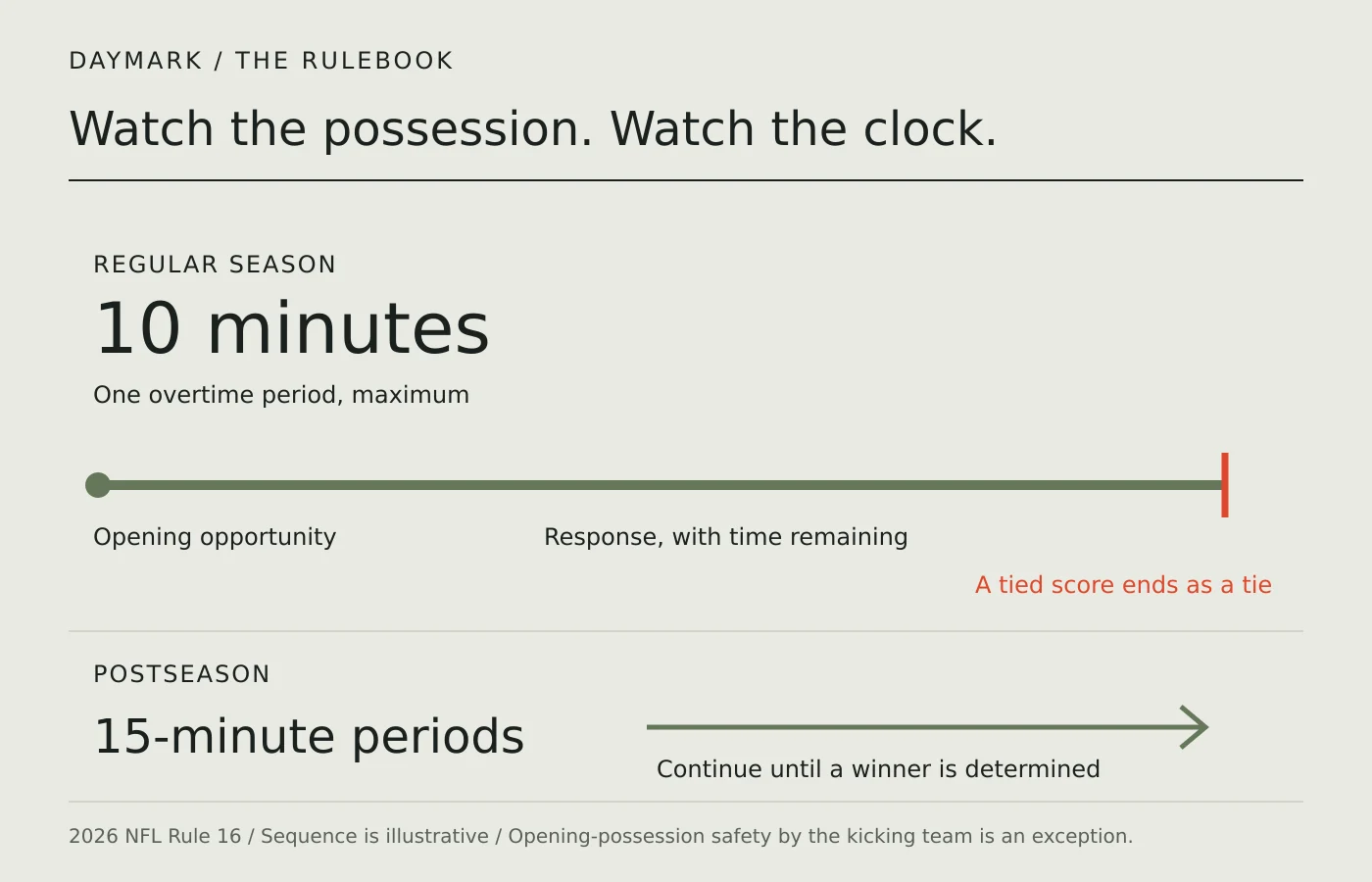
Regular-season overtime has one period lasting no more than ten minutes. The cap applies even when the second team has not had its opportunity or has not completed its initial possession. If the score is tied when the period ends, the game is a tie. Both teams' opportunity language therefore should not be rewritten as a promise of two full drives regardless of time remaining.
Imagine an illustrative game in which the first team holds the ball for much of the extra period and then scores. The opponent's task depends on both the deficit and the remaining clock. Television graphics saying each team gets a possession can hide this important constraint. Watching the clock beside the possession sequence gives a clearer account than assuming the officials must add enough time for another drive.
An opening score changes the answer required
When the opening offense scores a field goal, the opponent can answer; an opening offensive touchdown also allows an answering opportunity under the current rule. The teams' eventual totals, not merely the first score, matter at this stage. After the required opportunities, a team ahead wins. If the first team does not score, or the teams remain tied after their opportunities, the next score wins.
Use an illustrative scoreboard rather than memorizing one slogan. If the opening team earns three points, the responding offense needs to consider whether its possible result would leave it behind, level, or ahead. If the opening team earns a touchdown and conversion, the responding team faces a different deficit. Decisions about a conversion can matter because the comparison is between actual points, not just whether both offenses reached the end zone.
There are exceptions to a tidy two-drive story
The rulebook specifies an immediate win when the team kicking off to begin overtime scores a safety against the receiving team on that initial possession. It also defines an opportunity during kicking plays: a kickoff can supply the receiving team's opportunity even if the kicking team legally recovers it. Opportunity is therefore a rule-defined concept, not always an ordinary offensive series beginning with a snap.
Turnovers can make the sequence less tidy too. When you see an interception, fumble, recovery, or penalty, let the down and officiating process finish before announcing the result. The rulebook includes provisions for changes of possession and fouls. A short guide cannot safely replace all of them with the phrase first team to score. For an unusual play, find the relevant rule and the officials' ruling rather than extrapolating from a normal drive.
The postseason must produce a winner
Postseason overtime uses fifteen-minute periods and continues when a winner has not been decided, including when the second team's initial possession remains unfinished at the end of a period. This is the key difference from the regular-season cap. A playoff game cannot simply stop as a tie because the first extra period expired. The opening-possession safety exception still applies.
If an old playoff clip shows the clock approaching zero, ask whether it marks the end of an overtime period or the end of the game. Those are not the same event. Changing ends or beginning another period does not automatically erase the situation that officials must carry forward. Keeping the postseason format separate from the regular-season format prevents an otherwise accurate description of one from being applied to the other.
Describe the next play with the right context
A helpful explanation during a broadcast is specific: this is the first or responding possession, the offense trails by the stated amount, and this much time remains in the applicable format. That tells a new viewer why a field-goal attempt, fourth-down choice, or conversion decision matters. It also allows the explanation to change as the score and sequence change, rather than repeating an outdated rule from memory.
Before sharing a rules claim, open the season's official rulebook and check Rule 16. Distinguish a proposed change from one adopted by the clubs, and distinguish the year of a highlight from the year of the rules you are quoting. The examples here are illustrative and are not accounts of actual games. For a disputed result, the precise play, any fouls, and the official ruling are necessary to assess the procedure accurately.
Go to the sources
- NFL Football Operations: Official 2026 rulebook
- NFL: Official 2026 Playing Rules PDF, Rule 16
- NFL Football Operations: Featured rules and 2025 overtime change
- NFL Football Communications: Approved 2025 playing rules
Our editorial standards explain how sources and automated briefings are handled.