Most discoveries begin with an indirect signal
A colorful picture of an unfamiliar planet can make a discovery look like a close-up photograph. Often the evidence begins as measurements of the planet's star. NASA describes the transit and radial-velocity methods among the main ways of finding exoplanets. These techniques detect changes associated with an orbiting object. The resulting measurements can support a discovery even when the telescope does not resolve the planet as a separate image.
That distinction is worth checking in a news story. Find the observation used, the instrument that recorded it, and whether the accompanying image is an artist's concept, a simulation, or actual imaging data. A reconstruction can communicate a hypothesis beautifully, but its clouds, colors, or landscape may not have been measured. The scientific claim should be read from the evidence and paper rather than from the picture's realism.
What a transit tells researchers
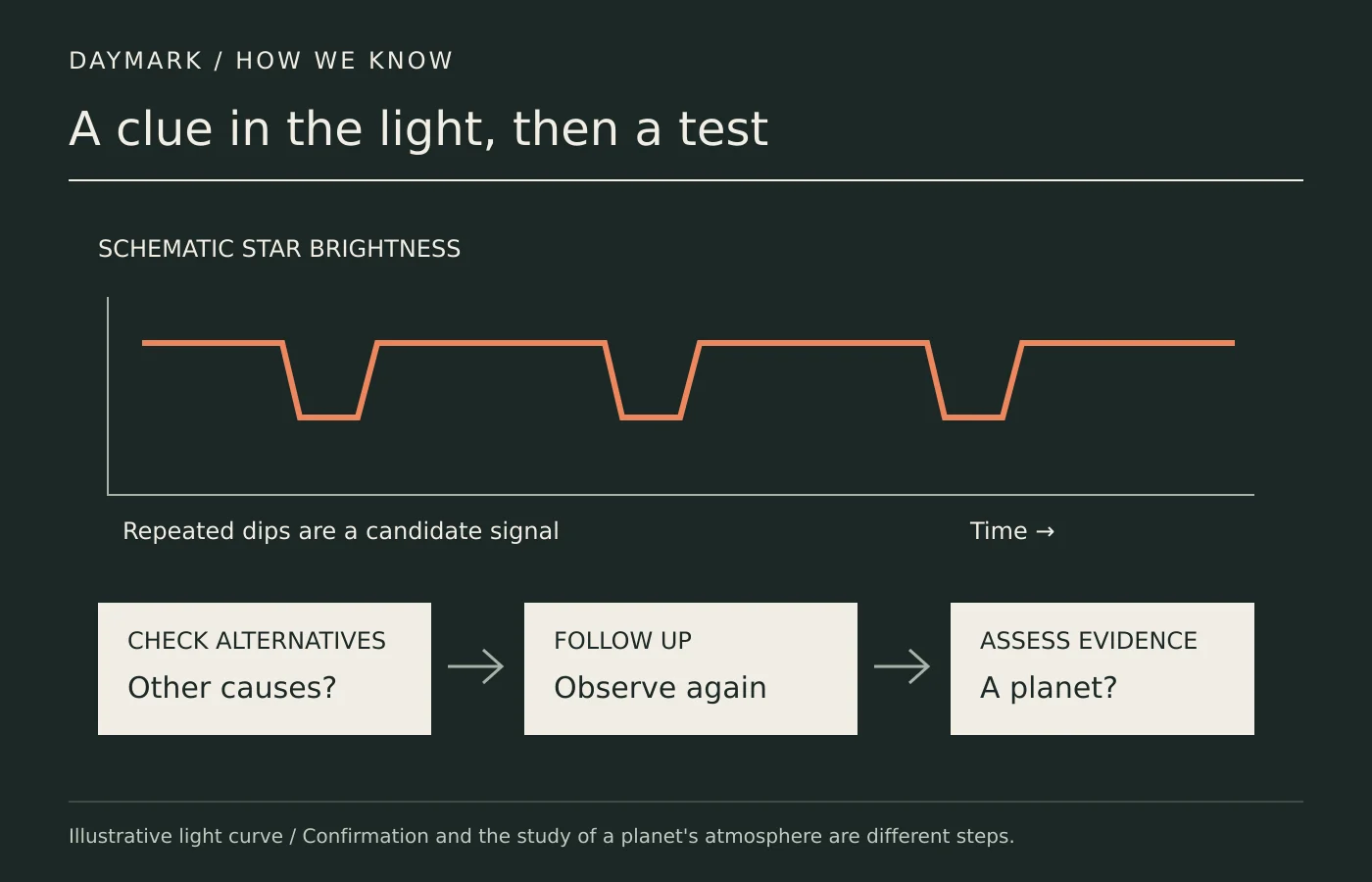
When an orbiting planet passes between its star and the observer, it can block a small portion of the star's light. Plotting brightness against time produces a light curve. Repeated dips with consistent timing are a promising clue. Their depth and duration help researchers estimate properties of the system, using information about the star and the geometry of the passage. The curve is a measurement to interpret, not a direct inventory of surface features.
The alignment matters. A planet whose orbit never crosses the star's face from our viewpoint will not produce that kind of transit for our telescope. Detection therefore depends on geometry and the observations available. When a search finds no transit, that result does not automatically establish that a star has no planets. Likewise, a transit survey's discovered population reflects what the method is able to detect, not an unbiased census of every possible world.
Try to explain the signal another way
NASA's guide to confirming planets describes the need to investigate alternatives. A companion star, other material crossing the line of sight, or an instrumental artifact can produce a misleading signal. Researchers examine whether the observation fits a planetary explanation better than plausible competitors. Repetition helps, but repetition alone is not sufficient if another phenomenon can repeat too. The aim is to test the cause of the signal, not merely to find an attractive pattern.
Follow-up observations can use another telescope or another technique. Higher-resolution observations may help reveal neighboring stars whose light contaminated the measurement. Additional data can check timing, depth, or other properties. The exact approach depends on the candidate and the available instruments. Avoid imposing a universal rule that every accepted discovery must have the same two tests; what matters is the strength of the evidence and the alternatives that were assessed.
A moving star offers another line of evidence
The radial-velocity method examines shifts in a star's spectrum as its motion toward or away from us changes. An orbiting companion's gravitational influence can contribute to that pattern. This provides a different kind of evidence from a brightness dip. Combining suitable measurements can constrain a planet's mass and size more usefully than either measurement alone, although those inferences still depend on the system and the quality of the data.
Other methods answer different observational problems. Direct imaging seeks to distinguish the planet's light from its much brighter star. Microlensing uses the gravitational effect of a foreground system on background light. Each technique has its own strengths and selection effects. A story becomes easier to evaluate when it explains why the chosen method could detect this object and what the method cannot tell researchers about it.
Confirmation is different from characterization
Once evidence establishes a planet, researchers can continue investigating its properties. Transit spectroscopy examines how light passing through an atmosphere varies with wavelength. That can provide evidence about atmospheric constituents, but the inference is not the same as directly sampling air at the planet's surface. Read the uncertainty, alternative interpretations, and whether an atmospheric feature is described as tentative or established.
The habitable zone describes a region where conditions could permit liquid water on a planet's surface, given an appropriate atmosphere. It is not confirmation that the planet has water or supports life. A world's atmosphere, temperature, size, and many other conditions matter. Keep the steps distinct: detecting an object, establishing that it is a planet, studying its environment, and obtaining evidence of life are separate claims with different evidential demands.
Read the discovery in three passes
First identify the observation: a brightness change, spectral shift, resolved image, or other signal. Next ask what follow-up work tested the planetary explanation and where that analysis was published. Finally list the properties actually measured or inferred, with their uncertainties. This routine lets you appreciate a discovery without accidentally upgrading an orbital measurement into a detailed account of an unseen landscape.
Pay attention to the words candidate, confirmed, and characterized, and consult the linked paper or catalog when the distinction is unclear. A scientific catalog can be updated as analyses improve. That is part of examining a distant system through limited evidence. The most informative account gives readers both the achievement and the remaining questions, rather than treating the word discovery as the end of the investigation.
Go to the sources
- NASA: How we find and characterize exoplanets
- NASA: Ten steps to confirm a planet around another star
- NASA: Exoplanet facts
- NASA: The habitable zone
Our editorial standards explain how sources and automated briefings are handled.